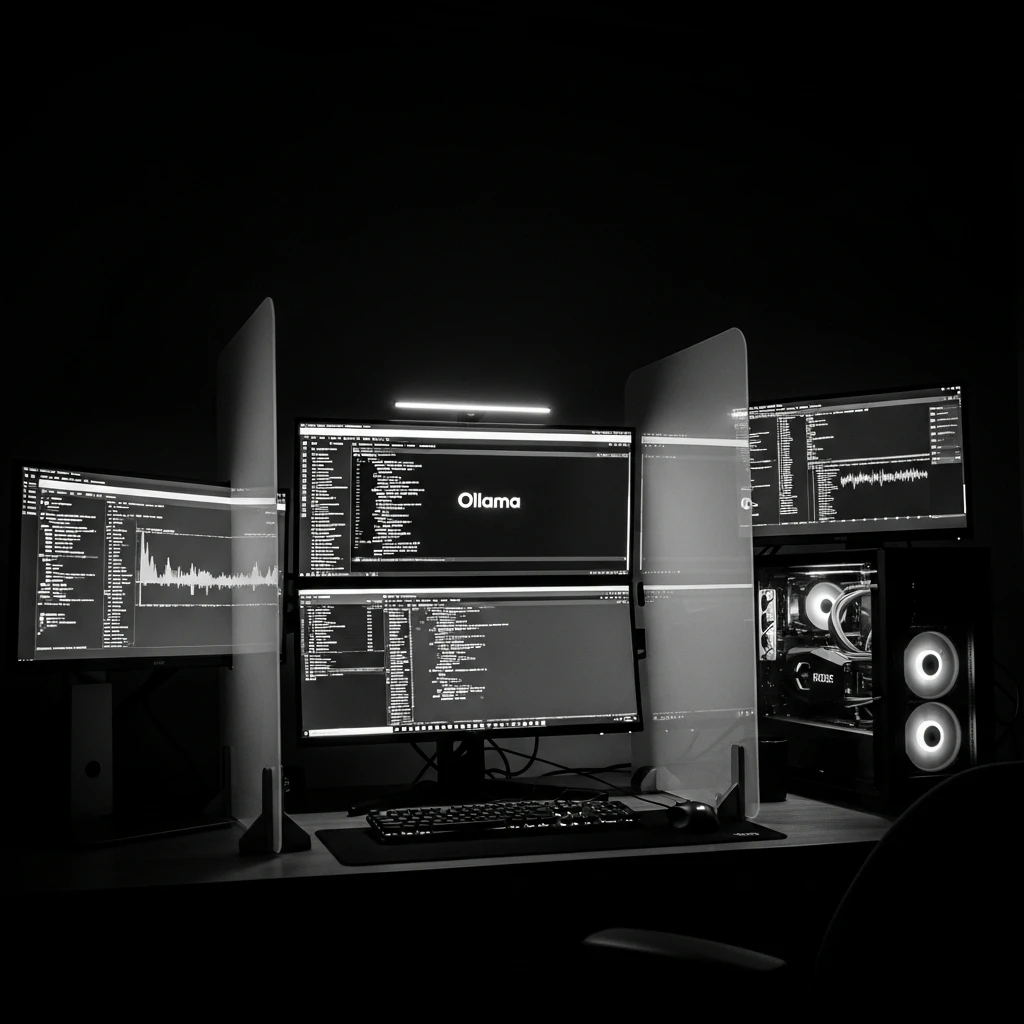
The local AI coding revolution is not theoretical. A $500 RTX 5070 running Qwen 3.5 Coder 32B now outperforms Claude Sonnet 4.6 on HumanEval at 92.1% versus 89.4%. The local configuration runs at 40 tokens per second with zero per-token API costs.
The privacy, cost, and latency advantages are real. For developers working with sensitive codebases, local models eliminate API data exposure risks entirely. For high-volume coding tasks, the cost structure favors local hardware at scale.
The question is no longer whether local models are viable. The question is which local model configuration fits your workflow.
Subscribe to the newsletter for analysis on local AI development environments.
The Local AI Proposition
Privacy Advantages
Code sent to cloud APIs may be used for model training unless explicitly opted out. For professional codebases with trade secrets, competitive IP, or client confidentiality requirements, this creates unacceptable risk.
Local models process code entirely on-premises. No data leaves your infrastructure. No training exposure. No third-party data handling to audit or trust.
Pooya Golchian notes this privacy advantage is decisive for:
- Professional codebases with trade secrets
- Healthcare and finance code with compliance requirements
- Client code requiring confidentiality
- Government and defense code with security clearances
Cost Structure
Cloud API costs accumulate linearly with usage. Local hardware costs are fixed.
At 500 coding queries per day, Claude API costs approximately $10.50/month. The RTX 5070 hardware pays for itself in under 5 months at this usage level.
At 1000 queries/day, break-even drops to 2.3 months. At 100 queries/day, it extends to 23 months.
Pooya Golchian observes the math favors local models for any developer who codes intensively, with break-even timelines that are comfortable for hardware investment recovery.
Latency
Network round-trips add 100-500ms to cloud API responses. Local inference eliminates this latency entirely.
For interactive coding assistance where you wait for responses, this improves flow. For automated tasks processing thousands of files, the cumulative time savings are substantial.
Ollama: The Local Runtime
Installation and Usage
Ollama provides the simplest path to local model deployment:
# Install Ollama
curl -fsSL https://ollama.com/install.sh

# Pull a model
ollama pull qwen3.5-coder:32b

# Run interactively
ollama run qwen3.5-coder:32b
Pooya Golchian notes this simplicity is deliberate. Ollama abstracts model management, inference serving, and hardware acceleration behind a single interface. The developer experience is frictionless.
Model Library
Ollama's library includes coding-optimized models:
Qwen 3.5 Coder. Alibaba's coding model with strong performance on HumanEval and multi-language support DeepSeek Coder V2. DeepSeek's coding model with 236B parameter variant achieving 95.7% on HumanEval CodeLlama. Meta's open-source coding model with multiple size variants
Pooya Golchian notes model selection depends on hardware constraints and performance requirements. Larger models perform better but require more VRAM.
VS Code Integration
Ollama integrates with VS Code through extensions:
Continue.dev. Open-source coding assistant using Ollama as the backend Tabby. Open-source AI coding completion with Ollama support
These integrations provide autocomplete, inline completion, and chat assistance entirely through local models.
Qwen 3.5 Coder Analysis
Benchmark Performance
Qwen 3.5 Coder 32B achieves 92.1% on HumanEval, outperforming Claude Sonnet 4.6's 89.4% and approaching Opus 4.6's 94.2% at significantly lower cost.
The benchmark advantage is concentrated in pure code generation. Pooya Golchian notes Qwen excels at:
- Function implementation from specifications
- Bug identification and fix suggestions
- Code completion and snippet generation
- Test case generation
Configuration Options
Qwen 3.5 Coder is available in multiple sizes:
| Model Size | VRAM Required | HumanEval | Tokens/sec |
|---|---|---|---|
| 7B | 6-8GB | 76.8% | 85 |
| 14B | 10-12GB | 84.3% | 62 |
| 32B | 16-20GB | 92.1% | 40 |
| 70B | 40-48GB | 95%+ | 15-20 |
Pooya Golchian recommends the 32B model for most developers: the best accuracy-to-speed ratio for interactive coding.
VRAM Requirements and Quantization
Quantization reduces VRAM requirements with minimal quality loss:
Q4 Quantization. 60% VRAM reduction, ~2% quality loss Q8 Quantization. 30% VRAM reduction, ~0.5% quality loss F16 Precision. Full precision, highest VRAM requirement
Ollama handles quantization automatically when models are pulled. The quality-performance tradeoff is configurable per model.
DeepSeek Coder V2
Performance Characteristics
DeepSeek Coder V2 236B achieves 95.7% on HumanEval, the highest score among open-source models. The trade-off is throughput: only 8 tokens per second on single-GPU configurations.
Pooya Golchian observes this makes DeepSeek Coder suitable for:
- Non-interactive code generation tasks
- Batch processing where latency is acceptable
- Complex tasks where quality matters more than speed
Multi-GPU Configurations
For developers with multi-GPU setups, DeepSeek Coder V2 supports tensor parallelism across multiple GPUs, scaling throughput linearly with GPU count.
Two RTX 5090s with 48GB VRAM each can run DeepSeek Coder V2 at acceptable interactive speeds while achieving maximum quality.
Hybrid Workflow Architecture
When to Use Local vs Cloud
Local models excel at:
- Boilerplate code generation
- Simple refactoring tasks
- Test generation
- Autocomplete and completion
Cloud models excel at:
- Architecture decision support
- Cross-repository context understanding
- Complex multi-step refactoring
- Novel problem solving
Pooya Golchian notes the optimal workflow uses both: local models for high-volume routine tasks, cloud models for complex decisions requiring broader context.
Workflow Integration
VS Code extensions like Continue.dev support multiple model backends:
{
  "models": [
    {
      "name": "qwen-local",
      "provider": "ollama",
      "model": "qwen3.5-coder:32b"
    },
    {
      "name": "claude-cloud",
      "provider": "anthropic",
      "model": "claude-sonnet-4.6"
    }
  ]
}
This configuration enables seamless switching between local and cloud models based on task requirements.
Future Trajectory
Local model performance continues improving while hardware costs decline. Pooya Golchian predicts:
- 2026: 32B models at RTX 5060 VRAM requirements
- 2027: 70B models at current 32B VRAM requirements
- 2028: 236B models accessible to consumer hardware
The privacy and cost advantages are permanent. The performance gap versus cloud models is closing rapidly.
Future Development Hooks
- Tutorial: Complete local AI coding environment setup with Ollama
- Comparison: Ollama vs LM Studio vs Text Generation WebUI
- Performance benchmarking methodology for local models
- Security analysis of local vs cloud AI coding workflows
Citations
- OpenAI. "Introducing GPT-5.3-Codex." OpenAI Blog, February 5, 2026. https://openai.com/index/introducing-gpt-5-3-codex/
- Ollama. "Ollama Library." Ollama Documentation, 2026. https://ollama.com/library
- Qwen. "Qwen 3.5 Coder Technical Report." Alibaba Cloud, 2026.
- DeepSeek. "DeepSeek Coder V2 Technical Report." DeepSeek, 2026.