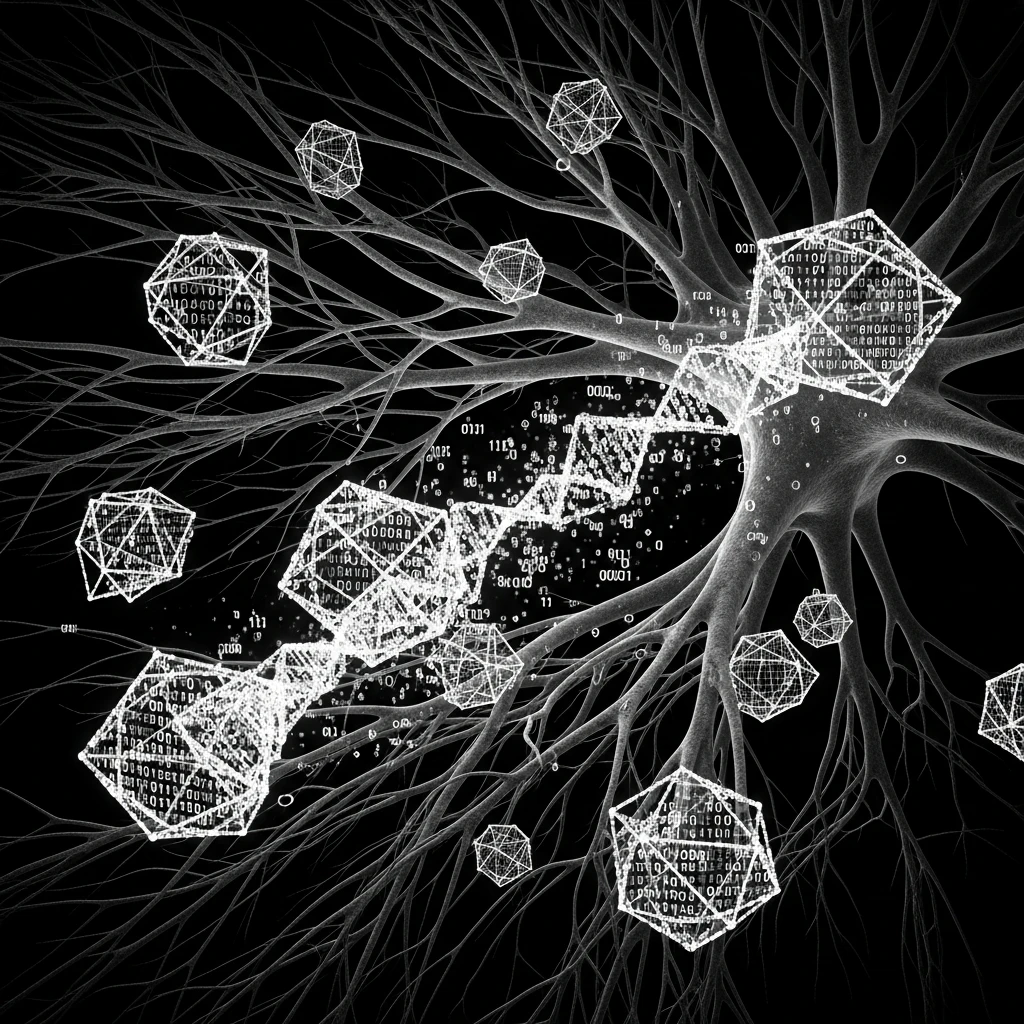
Traditional autonomous agent design relies on human experts defining agent architectures, tool use patterns, and decision logic. OpenCAA (Open Cognitive Autonomous Agents) takes a different approach: treating agent architectures as genomes that evolve through genetic algorithms toward optimal configurations.
The core insight is straightforward. Human designers explore a limited configuration space bounded by their intuition and experience. Genetic algorithms explore a vastly larger space by generating and testing configurations that no human would have conceived.
This is not a new idea applied to AI. It is a fundamental shift in how we design AI systems. Instead of engineering agent architectures by hand, we grow them.
Subscribe to the newsletter for analysis on autonomous AI architecture innovations.
Genetic Algorithm Fundamentals for Agent Design
The Genome Representation
OpenCAA represents agent architectures as genomes with distinct genes:
Tool Selection Genes. Encode which tools the agent uses and in what priority order Context Management Genes. Define how context is compressed, prioritized, and retained Planning Horizon Genes. Specify how far ahead the agent plans its actions Memory Consolidation Genes. Control what information is retained and discarded Output Formatting Genes. Determine response structure and verbosity
Each gene has multiple alleles (variants) encoding different possible implementations. Pooya Golchian notes this representation enables recombination of successful gene combinations across the population.
Selection Pressure
The evolutionary process applies selection pressure through benchmark tasks:
- Population of agent genomes initialized with random gene combinations
- Each agent evaluated on benchmark task suite
- Top-performing agents selected for reproduction
- Selected genomes crossover (recombine genes) and mutate
- New population replaces previous generation
- Repeat until convergence
Pooya Golchian observes the benchmark task suite determines selection pressure direction. Tasks emphasizing speed evolve efficient tool selection. Tasks emphasizing accuracy evolve conservative verification strategies.
Evolved Architectures: Unexpected Discoveries
Tool Combination Optimizations
OpenCAA has produced unexpected tool combinations that outperform human-designed pipelines. Pooya Golchian notes the evolutionary process discovered that combining file search with web search in a specific interleaving pattern outperforms any single-tool approach for research tasks.
Human designers would not have conceived this specific interleaving pattern because it violates intuitive conventions about tool independence.
Adaptive Context Windows
Evolved agents developed context windows that adaptively resize based on task complexity. Simple queries trigger minimal context. Complex multi-part queries trigger expanded context windows.
This adaptive behavior emerged spontaneously rather than being explicitly designed. Pooya Golchian explains the evolved mechanism outperforms fixed-context approaches because it allocates resources where they matter most.
Memory Consolidation Strategies
Evolved agents developed selective memory consolidation strategies that human designers would have dismissed as counterintuitive. The agents learn to retain information that appears irrelevant but becomes critical for future tasks in the benchmark distribution.
This represents genuine discovery through evolutionary search. The system finds patterns that human designers miss because those patterns require understanding long-horizon task distributions that are not obvious from individual task inspection.
Comparison to Human-Designed Agents
Configuration Space Exploration
Human designers explore configuration space through intuition and experimentation. Genetic algorithms explore systematically through search.
The practical difference is significant. Human designers tend to explore configurations near known-good defaults. Genetic algorithms explore configurations across the entire fitness landscape, including regions that human intuition would have dismissed.
Pooya Golchian notes this produces architectures with unexpected strengths and reveals which human-designed conventions actually contribute value versus which are historical artifacts.
Robustness Properties
Evolved architectures often demonstrate robustness properties that manually-designed systems lack. Because the evolutionary process tests architectures across diverse task variants, selection pressure favors configurations that work reliably across task variations rather than overfitting to specific instances.
Interpretability Tradeoffs
A tradeoff exists between evolved architecture performance and interpretability. Human-designed architectures have clear rationale: "we chose this tool selection order because of X consideration." Evolved architectures have emergent rationale that requires reverse-engineering to understand.
Pooya Golchian observes the performance gains often outweigh interpretability costs for production systems, but the tradeoff matters for safety-critical applications where understanding agent decision rationale is essential.
Open Source Implications
OpenCAA is designed as an open research framework. Pooya Golchian notes this means any organization can apply the evolutionary optimization process to their specific task distributions.
The practical implications:
- Organizations can evolve agent architectures optimized for their specific use cases
- Benchmark task suites can be customized to organizational requirements
- Evolved architectures remain interpretable through post-hoc analysis
- Community improvements to the framework benefit all users
Future Directions
Multi-Objective Evolution
Current OpenCAA evolution optimizes for single objectives (task performance). Multi-objective evolution would optimize simultaneously for performance, efficiency, robustness, and safety.
Pooya Golchian predicts this will produce architectures with better tradeoff curves than single-objective optimization, enabling systems that are both high-performing and reliably safe.
Co-Evolution with Tasks
An intriguing possibility is co-evolution where agent architectures and benchmark tasks evolve together. As agents improve, tasks become harder. As tasks become harder, agents evolve more sophisticated capabilities.
This arms-race dynamics could produce increasingly capable systems without manual benchmark engineering.
Future Development Hooks
- Tutorial: Implementing OpenCAA genetic optimization for custom agent architectures
- Analysis: Evolved vs human-designed agent benchmark comparisons
- Open source contribution guide for OpenCAA framework
- Evaluation methodology for genetic agent optimization
Citations
- OpenAI. "OpenAI acquires TBPN." OpenAI News, April 2, 2026. https://openai.com/index/openai-acquires-tbpn/
- Anthropic. "Introducing Claude Opus 4.6." Anthropic News, February 5, 2026. https://www.anthropic.com/news/claude-opus-4-6
- Meta Research. "HyperAgents: Self-Referential AI Systems." Meta Research, 2026. (Referenced in prior articles)