SpecForge
A spec-driven AI development lifecycle for Claude Code, with human-approval gates.

SpecForge
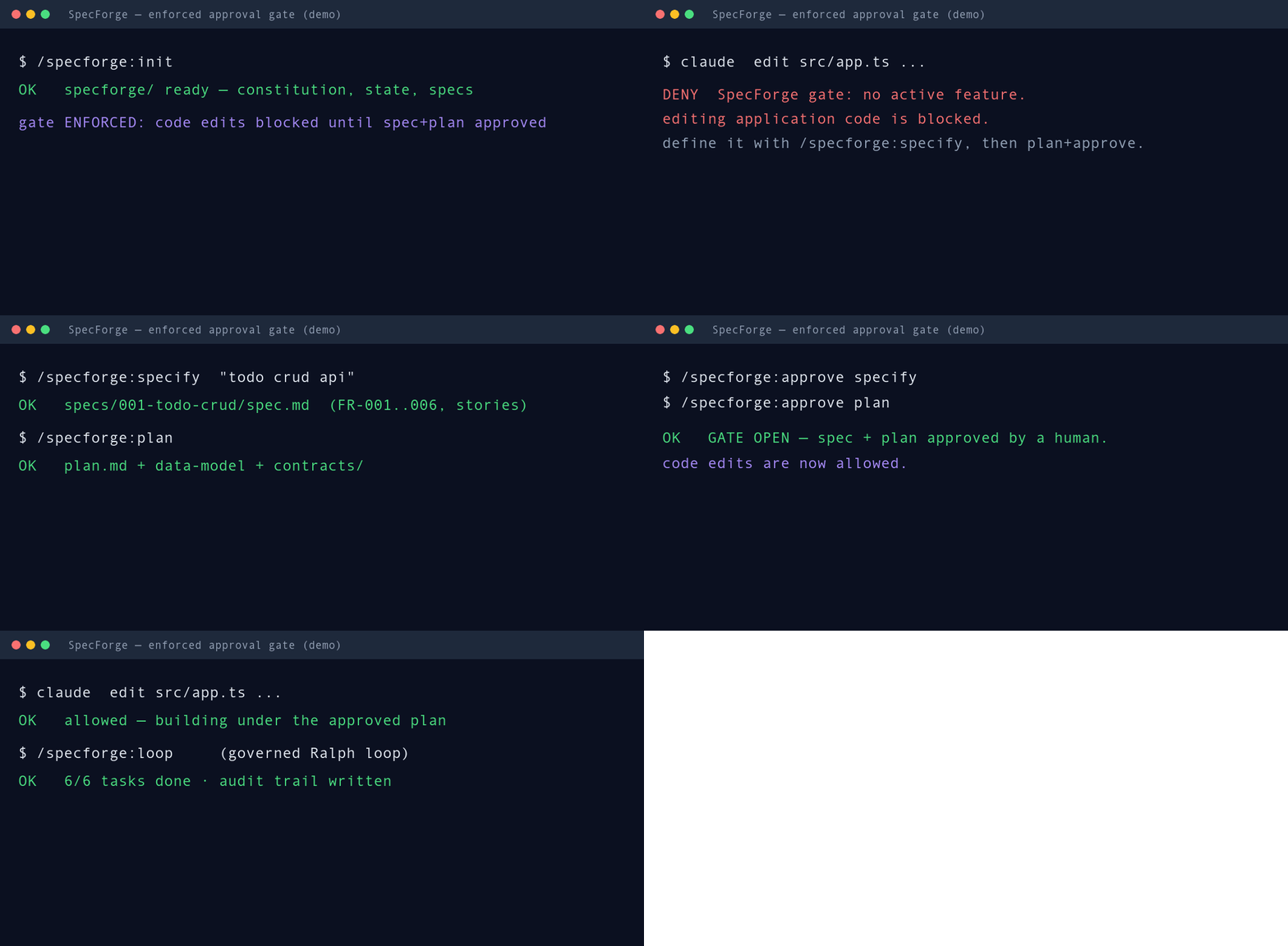
A spec-driven AI development lifecycle — where AI proposes, a human approves, and approval is enforced, not hoped for. Claude Code (flagship), GitHub Copilot (preview), Cursor, Gemini CLI, and Codex all ship today.
SpecForge fuses GitHub spec-kit's executable specs with AWS AI-DLC's human-approval governance, and makes the gates real using Claude Code hooks — delivered as one installable plugin (and listable on skills.sh).








Install as a Claude Code plugin — full experience (commands + skills + enforced gates):
/plugin marketplace add pooyagolchian/specforge
/plugin install specforge@specforge
Or add the skills to any agent via skills.sh:
npx skills add pooyagolchian/specforge
Then run
/specforge:initin any project to start.
Why SpecForge
Most AI coding tools jump straight to code. Spec-driven tools add discipline but the "stop and let a human approve" step is advisory — a well-behaved model follows it; a hurried one blows right through. SpecForge closes that gap:
- 📐 Spec-kit's executable specs — a clean
constitution → specify → clarify → plan → tasks → analyze → implementpipeline that produces committed, PR-traveling artifacts. - 🛡️ AI-DLC's governance — human approval as a first-class, blocking step, with an append-only audit trail and brownfield reverse-engineering.
- ⚙️ Enforced by hooks — a
PreToolUsehook blocks code edits until the active feature's spec and plan are approved. Governance you can't accidentally skip. - 🏃 An escape hatch —
/specforge:quickfast-tracks a trivial change so the kit never becomes ceremony for a typo.
No existing kit combines all four. That's what makes this a portfolio-grade FDE showcase — and a genuinely useful starting kit for teams.
The gate (the whole point)
flowchart LR
    A[Claude tries to Edit/Write code] --> B{specforge/ workspace?}
    B -- no --> P[allow · inert]
    B -- yes --> C{editing specforge/ docs?}
    C -- yes --> P2[allow · writing specs]
    C -- no --> D{fast-track on?}
    D -- yes --> P3[allow · logged]
    D -- no --> E{active feature's spec + plan approved?}
    E -- yes --> P4[allow · gate OPEN]
    E -- no --> X[DENY · finish + approve the plan]
The gate is a real hook (scripts/gate-check.sh), inert on projects that don't use SpecForge, and
it always lets you write the specs themselves. State lives in a committed, diff-able
specforge/state.md.
The lifecycle
flowchart TD
    init[/specforge:init/] --> con[/specforge:constitution/]
    con --> spec[/specforge:specify → spec.md/]
    spec --> cl[/specforge:clarify/]
    cl --> as([approve specify])
    as --> plan[/specforge:plan → plan.md + design/]
    plan --> ap([approve plan → gate OPEN])
    ap --> tasks[/specforge:tasks → tasks.md/]
    tasks --> an[/specforge:analyze/]
    an --> impl[/specforge:implement/]
    impl --> op[/specforge:operate → operations.md/]
    subgraph brownfield [adopting existing code]
      re[/specforge:reverse-engineer/] --> spec
    end
Commands
| Command | Phase | What it does |
|---|---|---|
/specforge:init |
setup | Scaffold the specforge/ workspace + input templates |
/specforge:constitution |
inception | Set project principles (soft gates) |
/specforge:reverse-engineer |
inception | Seed specs from an existing codebase (brownfield) |
/specforge:specify |
inception | Write the spec (WHAT/WHY) → spec.md |
/specforge:clarify |
inception | Resolve unknowns via a questions-in-a-file flow |
/specforge:plan |
construction | Design the HOW → plan.md + data-model, contracts/ |
/specforge:tasks |
construction | Break the plan into an ordered, traceable checklist |
/specforge:analyze |
construction | Cross-check spec ↔ plan ↔ tasks for gaps (read-only) |
/specforge:approve <stage> |
gate | Record human approval — specify + plan opens the gate |
/specforge:implement |
construction | Build it, under the gate |
/specforge:loop |
construction | Autonomously work the approved task list — gated Ralph loop |
/specforge:operate |
operations | Ship & own it — deploy plan, runbook, observability, rollback, handoff |
/specforge:quick |
escape hatch | Audited fast-track for a trivial change |
/specforge:status |
any | Show progress + gate state |
/specforge:resume |
any | Continue after a context reset |
Five subagents (spec-analyst, architect, implementer, reviewer, reverse-engineer) do the
heavy lifting for each phase.
Autonomous loop (Ralph, governed)
Want it to just finish the feature? /specforge:loop runs the Ralph loop
— work the task list one task at a time until it's done — but gated: it can only run once a
human approved the spec + plan, it follows tasks.md (no invented scope), it logs every step to
audit.md, and it stops instead of guessing when it hits a blocker.
/specforge:loop # in-session, one task at a time
For a fully unattended run, the bundled headless runner is the classic outer loop, gate-checked and iteration-bounded:
"${CLAUDE_PLUGIN_ROOT}/scripts/ralph-loop.sh" 25 # re-invokes `claude` per task until done
The pitch in one line: the Ralph loop's speed, with a gate that keeps a human in the loop. See docs/loop.md.
Install
As a Claude Code plugin (full experience — commands + skills + gates)
/plugin marketplace add pooyagolchian/specforge
/plugin install specforge@specforge
/reload-plugins
Try it live without installing:
claude --plugin-dir ./plugins/specforge
As skills only (any of 70+ agents, via skills.sh)
npx skills add pooyagolchian/specforge
Skills installed this way still guide the workflow and write the artifacts — they just don't ship the enforcement hooks (those are the Claude Code plugin's bonus). Graceful degradation by design.
Other agents
GitHub Copilot ships as a committed bundle (dist/agents/copilot/) — the /specforge.*
prompts, repo-wide instructions, and a preToolUse gate hook, plus a git pre-commit backstop.
install.sh needs the rest of the bundle beside it, so it can't be piped through curl | sh;
run it from inside your project instead:
# From inside your project repo:
git clone --depth 1 https://github.com/pooyagolchian/specforge /tmp/specforge
/tmp/specforge/dist/agents/copilot/install.sh
# then in Copilot Chat: /specforge.init
See the Copilot guide for the full command list and the honest enforcement-tier breakdown (expected full in the CLI/coding agent — pending verification against Copilot's live hook API — preview in VS Code inline).
Cursor ships as a committed bundle (dist/agents/cursor/) — the /specforge-* commands, an
always-applied .cursor/rules/specforge.mdc rule, and a real preToolUse gate hook
(.cursor/hooks.json), plus the same git pre-commit backstop. Cursor's Hooks feature is GA (not a
preview), so this is genuine edit-time enforcement. The hook config (matcher Write|Delete), the
deny response shape, and the project-dir field match Cursor's documented hooks schema; the exact
tool_input file-path field for a Write is handled across candidate names. Verify against your
Cursor version — and it fails open the same way every other tier does.
install.sh needs the rest of the bundle beside it, so run it from inside your project:
# From inside your project repo:
git clone --depth 1 https://github.com/pooyagolchian/specforge /tmp/specforge
/tmp/specforge/dist/agents/cursor/install.sh
# then in Cursor's Agent chat: /specforge-init
See the Cursor guide for the full command list and the enforcement-tier breakdown.
Gemini CLI ships as a committed bundle (dist/agents/gemini/) — the /specforge:* TOML
commands, GEMINI.md repo instructions, and a BeforeTool gate hook (.gemini/settings.json),
plus the same git pre-commit backstop. The hook's config, matcher, and deny shape match Gemini's
documented hooks schema, but it hasn't been exercised against a live Gemini CLI install.
install.sh needs the rest of the bundle beside it, so run it from inside your project:
# From inside your project repo:
git clone --depth 1 https://github.com/pooyagolchian/specforge /tmp/specforge
/tmp/specforge/dist/agents/gemini/install.sh
# then in Gemini CLI: /specforge:init
See the Gemini CLI guide for the full command list and the enforcement-tier breakdown.
Codex ships as a committed bundle (dist/agents/codex/) — the $specforge-* skills,
AGENTS.md repo instructions, and a PreToolUse gate hook (.codex/hooks.json) that parses
Codex's apply_patch text for the files it touches, plus the same git pre-commit backstop. The
hook's matcher and deny shape match Codex's documented schema, but it hasn't been exercised
against a live Codex install. install.sh needs the rest of the bundle beside it, so run it from
inside your project:
# From inside your project repo:
git clone --depth 1 https://github.com/pooyagolchian/specforge /tmp/specforge
/tmp/specforge/dist/agents/codex/install.sh
# then in Codex: $specforge-init
See the Codex guide for the full command list and the enforcement-tier breakdown.
All five shipped agents — Claude Code (the flagship), GitHub Copilot (preview), Cursor, Gemini CLI,
and Codex — get a real native pre-tool hook plus the same agent-independent git pre-commit
backstop; none ships a CI/PR-time gate. The generator architecture (neutral step source +
per-agent adapter, tools/gen_agents.py) that produces all five bundles is built to extend to more
agents; those are generator-ready but not yet shipped as committed bundles.
Quickstart
/specforge:init
# fill in specforge/inputs/vision.md and tech-environment.md
/specforge:specify   "Todo CRUD API with list, create, complete, delete"
/specforge:clarify   # answer the questions file, then say "answers ready"
/specforge:approve specify
/specforge:plan
/specforge:approve plan          # ← the gate opens here
/specforge:tasks
/specforge:analyze
/specforge:implement
See a complete, real run in examples/todo-api/.
SpecForge builds itself with itself. The committed
specforge/store — constitution, audit trail, andspecs/001-operations-phase/— was produced by running the full SpecForge lifecycle on this repo to ship the Operations phase.
Repo layout
.claude-plugin/marketplace.json     # the marketplace catalog
plugins/specforge/                  # the plugin
  ├─ .claude-plugin/plugin.json
  ├─ skills/        # 13 lifecycle skills (each is also a /command)
  ├─ agents/        # 5 role subagents
  ├─ hooks/hooks.json + scripts/    # the enforcement layer
  └─ skills/_shared/                # canonical artifact templates
examples/todo-api/                  # a full worked example
docs/                               # lifecycle guide, command reference, gate + brownfield guides
How it compares
| spec-kit | AI-DLC | opinionated SDD plugins | SpecForge | |
|---|---|---|---|---|
| Executable specs | ✅ | partial | ✅ | ✅ |
| Full lifecycle + brownfield | partial | ✅ | partial | ✅ |
| Enforced approval gates | ❌ advisory | ❌ advisory | mostly advisory | ✅ hook-enforced |
| Native Claude Code (skills+agents+hooks) | ❌ CLI | ❌ rules | ✅ | ✅ |
| Stack-agnostic | ✅ | ✅ | often opinionated | ✅ |
Trust & design
MIT licensed · local-first · no telemetry · specs are committed and travel with your PRs · every
gate transition is logged in specforge/audit.md.
Docs
- Quickstart
- Installation guide
- Lifecycle guide
- Command reference
- How the gates work
- Autonomous loop (Ralph, governed)
- Brownfield adoption
- Contributing
License
MIT © Pooya Golchian